Congress
Additional Information
Congress
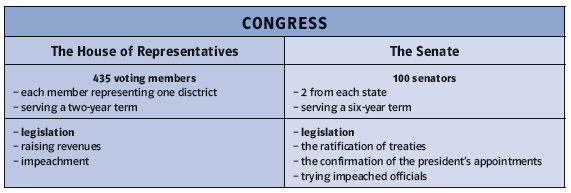
Congress constitutes the legislative branch of the political system. Consequently its chief concern is the proposing and passing of bills. It consists of two Houses, the Senate and the House of Representatives. In the Senate, all states are equally represented. There are two senators from each state. The number of representatives from each state, by contrast,
is determined by the size of its population. Consequently a district with a large population such as California has more representatives than a sparsely populated state such as Delaware. Thus a balance has been achieved between the larger or more heavily populated states and the smaller ones. While the two Houses have practically equal rights and seem to have nearly identical functions, there is a distinctive difference in the number of years its members serve, a fact which is of considerable consequence.
The Senate
One third of the senators are elected every two years for six terms of office so there is always a mixture of relatively new and very experienced senators. The sixyear term allows the senators to support measures which though perhaps unpopular at the moment might prove beneficial in the long term.
The House of Representatives
The members of the House of Representatives are elected every two years for two-year terms so naturally they cannot risk displeasing their voters at home by supporting a scheme which might benefit the state as a whole (e.g. an environmental project) but endanger or cost thousands of jobs in their home district (e.g. in the oil or logging industry). Thus they truly represent the people.
The powers of Congress
The power to declare war exclusively lies with Congress.
Each house of Congress has the power to initiate legislation and each bill goes through several stages in both houses:
- Once a bill has been introduced in either of the two houses, it is sent to a committee for closer consideration.
- Then it is sent to the house where it was first introduced. After considering and debating the bill, it is then voted on.
- Once a bill is approved by one house, it is sent to the other house where it undergoes a similar process.
Each house has the power to vote for or against a bill. It might also propose amendments. It takes the consent of both houses for a bill to become a law. When both sides agree, the bill is sent to the president for his signature. Complicated as this process might be and though it sometimes requires compromise, it is an effective measure against rash legislation. The Constitution also grants each chamber unique powers:
- The Senate alone has the power to confirm or reject the president’s choice of officials (e.g. it must confirm the appointment of judges of the Supreme Court).
- The ratification of any treaty is subject to the consent of the Senate.
- The Senate alone has the power to try impeached officials whereas the House of Representatives alone has the power of impeachment.
- The power to raise money rests with the House of Representatives alone though the Senate might propose amendments.